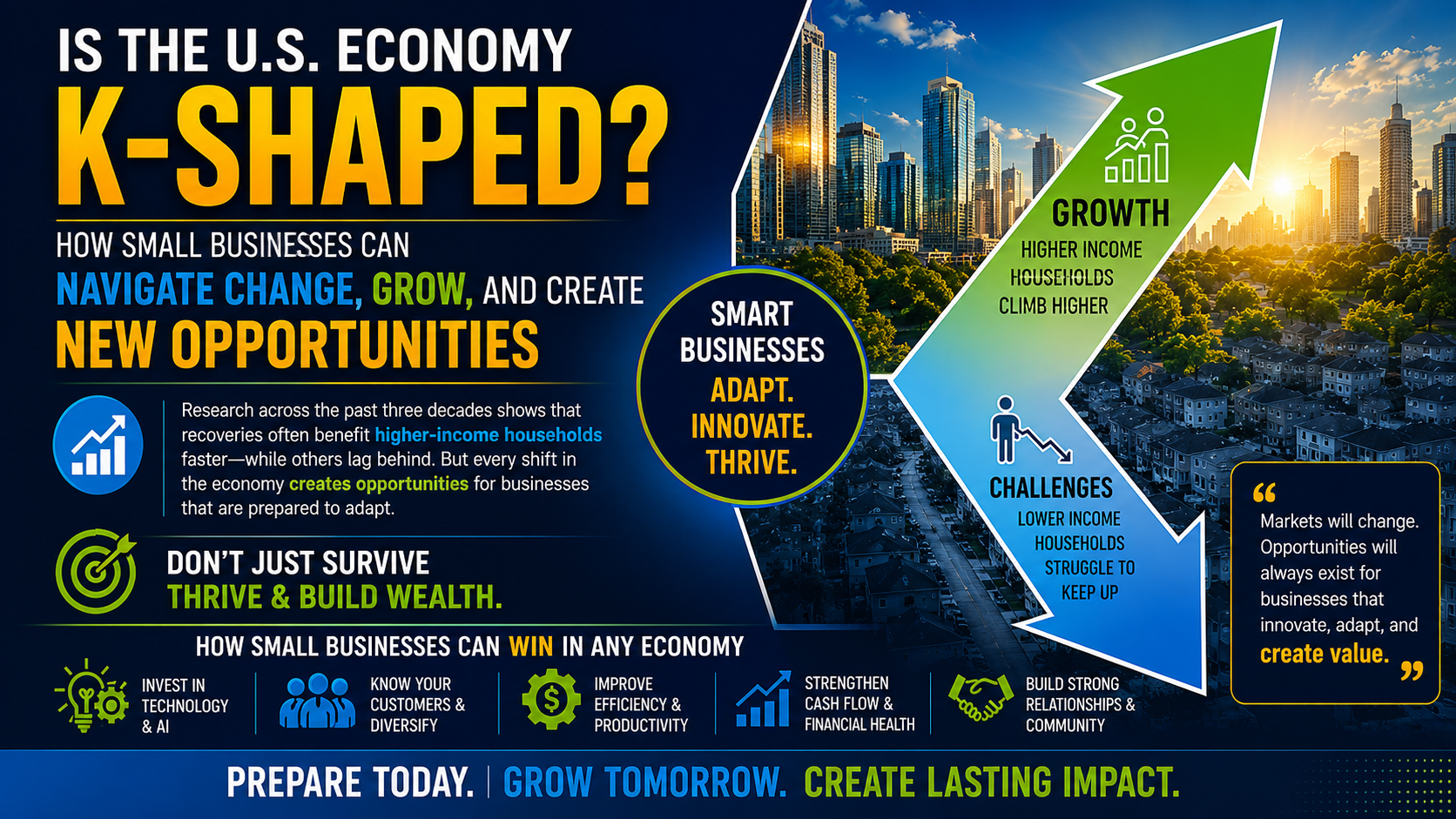
Is the U.S. Economy K-Shaped? How Small Businesses Can Navigate Change, Grow, and Create New Opportunities
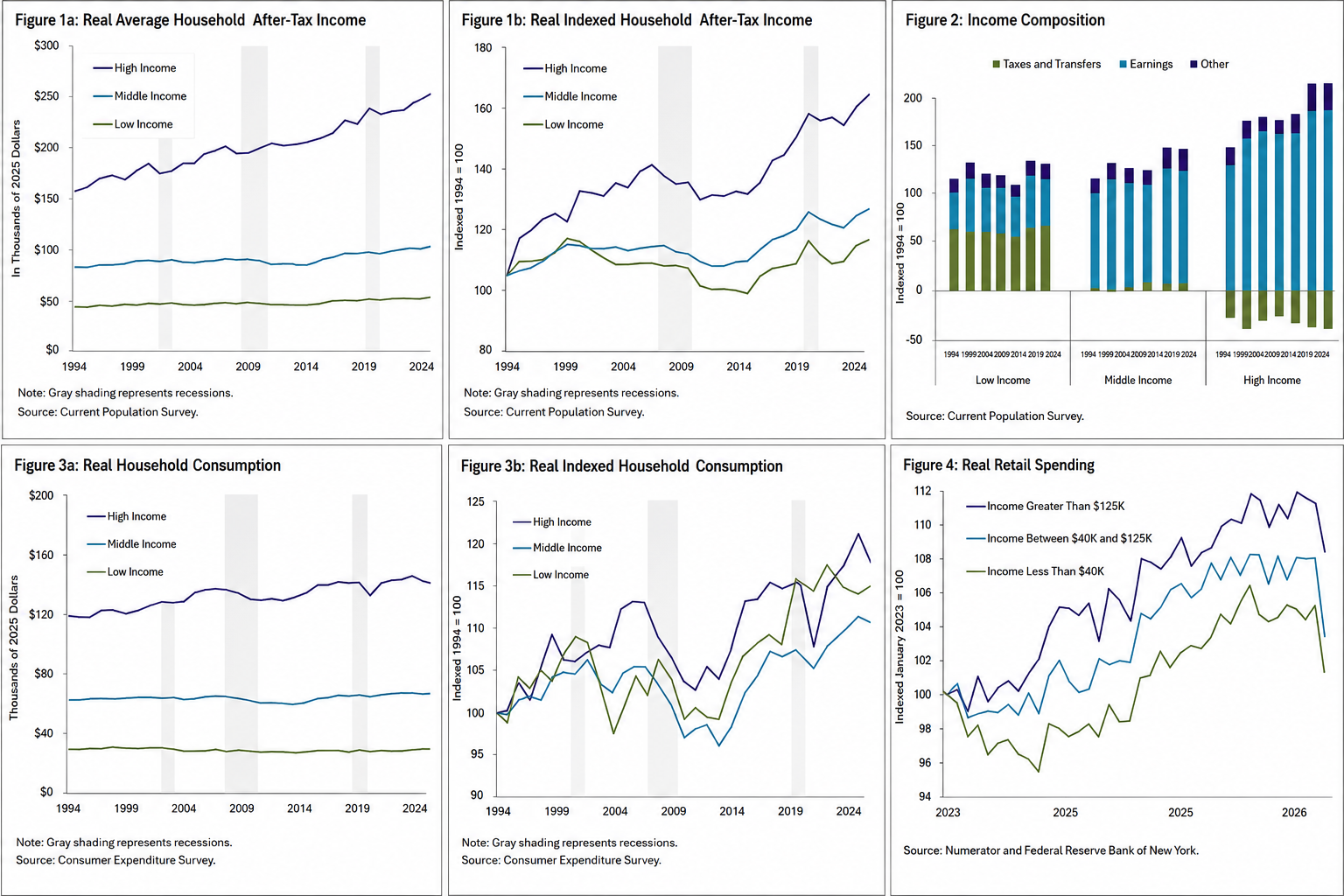
Over the past three decades, the U.S. economy has experienced periods where different groups of Americans have recovered at dramatically different speeds. Economists describe this phenomenon as a K-shaped economy—one where higher-income households continue moving upward while lower-income households struggle or recover more slowly. According to a July 2026 study by the Federal Reserve Bank of Richmond, the United States has not experienced a permanently K-shaped economy over the past thirty years, but there have been several significant periods—particularly following the 2001 recession and the Great Recession of 2007–2009—where income growth favored higher-income households while lower-income households experienced stagnation or decline. More recently, although income growth after the COVID-19 recession was more broadly shared due in part to government support programs, consumer spending patterns have once again begun showing signs of divergence, suggesting that economic opportunities are increasingly uneven across different segments of society.
For entrepreneurs and small business owners, the question is not whether the economy is K-shaped—it is how to thrive regardless of which direction the economy moves. Economic shifts create both winners and losers, but businesses that understand changing consumer behavior can position themselves on the upward side of growth. The data show that higher-income households have experienced substantially faster income growth over the past three decades, while overall consumer spending has remained more resilient than income alone would suggest. This means businesses must recognize that different customer segments have different purchasing power, priorities, and expectations. Rather than relying on a single market, successful businesses diversify their customer base, develop multiple revenue streams, and create products or services that appeal to a range of income levels.
A changing economy also highlights the importance of operational efficiency. Businesses that invest in technology, automation, artificial intelligence, customer relationship management systems, digital marketing, and financial management are better equipped to weather economic uncertainty. Instead of simply cutting expenses during slower periods, successful companies improve productivity, strengthen customer relationships, and make smarter decisions using real-time business data. Every economic disruption creates opportunities for businesses that are willing to innovate while competitors hesitate.
Consumer behavior continues to evolve. Higher-income households may continue spending on premium products and experiences, while middle- and lower-income consumers become increasingly focused on value, convenience, and affordability. Businesses that offer flexible pricing, subscription services, financing options, loyalty programs, and personalized customer experiences are often better positioned to retain customers regardless of economic conditions. Understanding these differences allows entrepreneurs to market more effectively instead of treating every customer the same.
The Federal Reserve's research also reminds us that income and consumption do not always move together. Even when income growth slows, consumers often continue spending by using savings, borrowing, or adjusting purchasing priorities. For small businesses, this means that customer demand rarely disappears—it shifts. Companies that regularly monitor market trends, customer feedback, and purchasing behavior can adapt faster than those waiting for conditions to improve.
At Black & Brown Founders Economic Research & Development (BBFERD), we believe every economic cycle creates new opportunities for prepared entrepreneurs. Our focus is helping businesses become financially stronger, operationally smarter, and investment-ready through business education, AI-powered tools, financial coaching, capital readiness programs, and strategic planning. Whether the economy is expanding, slowing, or becoming increasingly divided, entrepreneurs who build resilient systems, strengthen cash flow, embrace technology, and continuously improve their operations are far more likely to survive and thrive.
The economy will always change. Markets will rise and fall. Consumer spending will shift. But businesses that focus on innovation, adaptability, financial discipline, and customer value can continue creating jobs, building wealth, and expanding opportunities regardless of economic conditions. In a K-shaped economy, success belongs to businesses that are prepared to climb while helping their communities grow alongside them.
Reference: DeMaria, Kyle; Jones, John Bailey; Mengedoth, Joe; and Neelakantan, Urvi. (July 2026) "Is the US Economy K-Shaped? Evidence From the Past Three Decades." Federal Reserve Bank of Richmond Economic Brief, No. 26-23. https://www.richmondfed.org/publications/research/economic_brief/2026/eb_26-23