
Build the Foundation: Conduct a Comprehensive Business Assessment
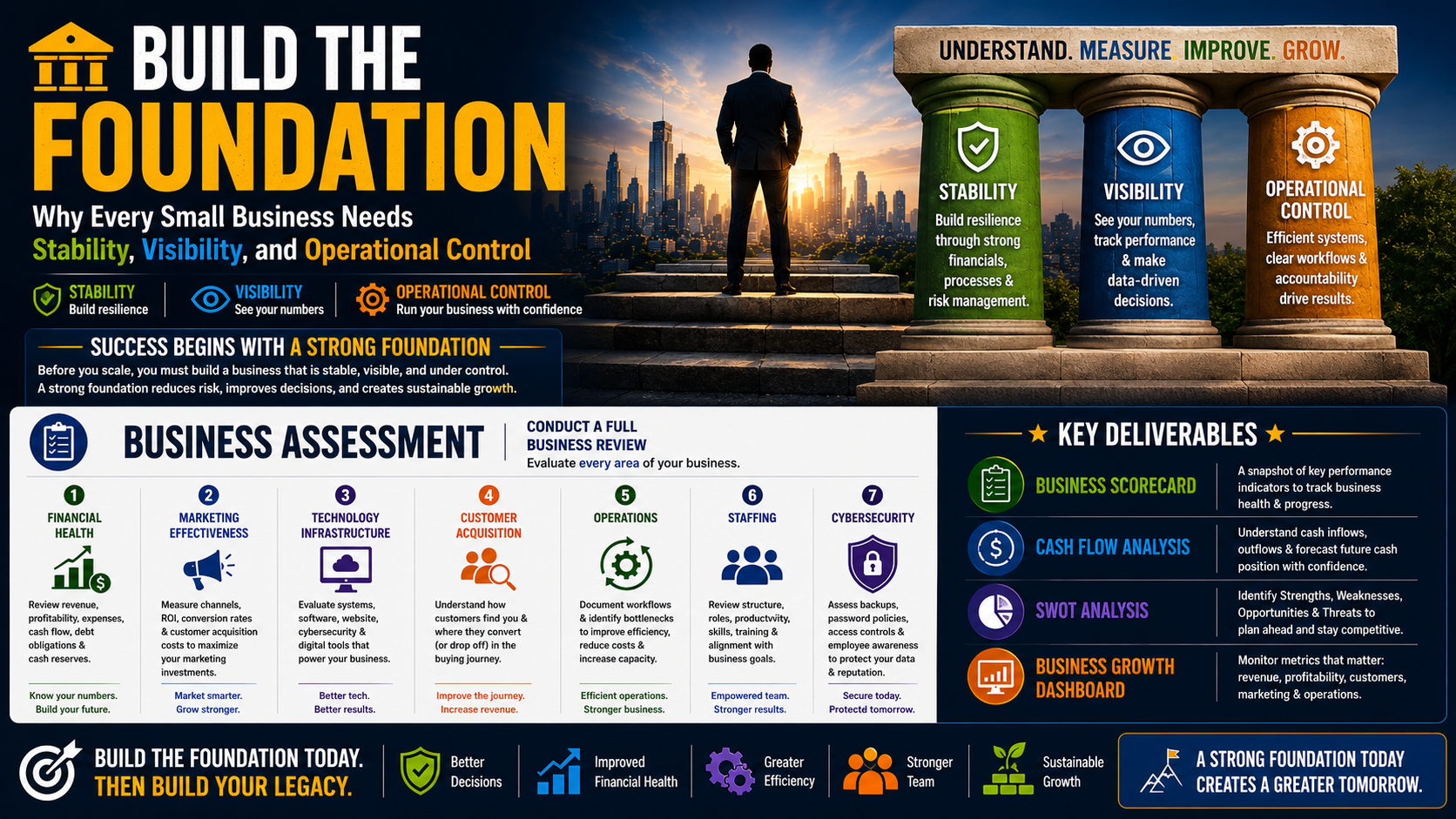
Why Every Small Business Needs Stability, Visibility, and Operational Control?
Success Begins with a Strong Foundation
Every successful skyscraper starts with a solid foundation. The same principle applies to small businesses.
In today's K-shaped economy, where some companies are accelerating toward growth while others struggle to survive, the businesses that consistently outperform their competitors share one common characteristic: they have built a strong operational foundation.
Before investing more money in marketing, hiring employees, or expanding into new markets, business owners should first focus on creating stability, visibility, and operational control. These three pillars enable informed decision-making, reduce risk, and position a business for sustainable long-term growth.
The Goal: Create Stability, Visibility, and Operational Control
A strong business foundation provides confidence during uncertain times and clarity when making strategic decisions.
Stability means having reliable financial management, documented processes, and the resilience to navigate market fluctuations.
Visibility means understanding your numbers, tracking key performance indicators, and knowing exactly how your business is performing.
Operational Control means having efficient systems, defined workflows, and the ability to manage growth without chaos.
Businesses that master these areas are better equipped to adapt, compete, and scale.
Conduct a Comprehensive Business Assessment
The first step in building that foundation is conducting a full business review.
Rather than relying on assumptions, owners should objectively evaluate every major component of the organization to identify strengths, weaknesses, opportunities, and risks.
1. Financial Health
Review revenue, profitability, expenses, debt obligations, cash reserves, and cash flow. Understanding the financial position of the company provides the basis for strategic planning and future investment.
2. Marketing Effectiveness
Measure which marketing channels produce qualified leads and customers. Evaluate return on investment, conversion rates, and customer acquisition costs to ensure marketing dollars are being spent wisely.
3. Technology Infrastructure
Assess the systems that power the business, including software, websites, cloud services, cybersecurity protections, and digital collaboration tools. Modern technology should simplify operations rather than create obstacles.
4. Customer Acquisition
Understand how prospective customers discover your business and where they convert—or fail to convert. Mapping the customer journey often reveals opportunities to increase revenue without significantly increasing costs.
5. Operations
Document workflows and identify bottlenecks that reduce efficiency. Standardized processes improve consistency, quality, and scalability.
6. Staffing
Evaluate organizational structure, employee responsibilities, productivity, and training needs. A well-aligned team is essential for long-term success.
7. Cybersecurity
Protecting business data is no longer optional. Review backup procedures, password policies, access controls, employee awareness, and cybersecurity safeguards to reduce operational risk.
Key Deliverables Every Business Should Produce
A successful business assessment should generate actionable tools that guide future decisions.
Business Scorecard
A concise snapshot of key performance indicators that tracks business health and highlights trends over time.
Cash Flow Analysis
A detailed review of cash coming into and leaving the business, helping owners anticipate shortages and make informed financial decisions.
SWOT Analysis
An evaluation of internal strengths and weaknesses alongside external opportunities and threats, providing a strategic framework for planning.
Business Growth Dashboard
A centralized reporting tool that monitors critical metrics such as revenue, profitability, customer acquisition, marketing performance, and operational efficiency.
Why Building the Foundation Matters
Many businesses fail not because of poor ideas but because they lack visibility into their operations and finances.
By investing time in assessment and planning, owners gain:
Better strategic decision-making
Improved financial management
Greater operational efficiency
Increased resilience during economic uncertainty
Stronger customer experiences
Higher confidence when seeking financing or partnerships
A scalable platform for future growth
Final Thoughts
Growth without structure can create instability. Expansion without visibility can magnify problems. Success without operational control is difficult to sustain.
The businesses that thrive in a K-shaped economy are the ones that understand their operations, measure what matters, and make decisions based on data rather than guesswork.
Take the time to evaluate your financial health, marketing effectiveness, technology infrastructure, customer acquisition strategy, operations, staffing, and cybersecurity. Build a Business Scorecard, perform a Cash Flow Analysis, complete a SWOT Analysis, and create a Business Growth Dashboard.
When you build the foundation first, growth becomes more intentional, more sustainable, and more profitable.
Build stability. Gain visibility. Take control. Then scale with confidence.