
The Power of Group Economics in a K-Shaped Economy
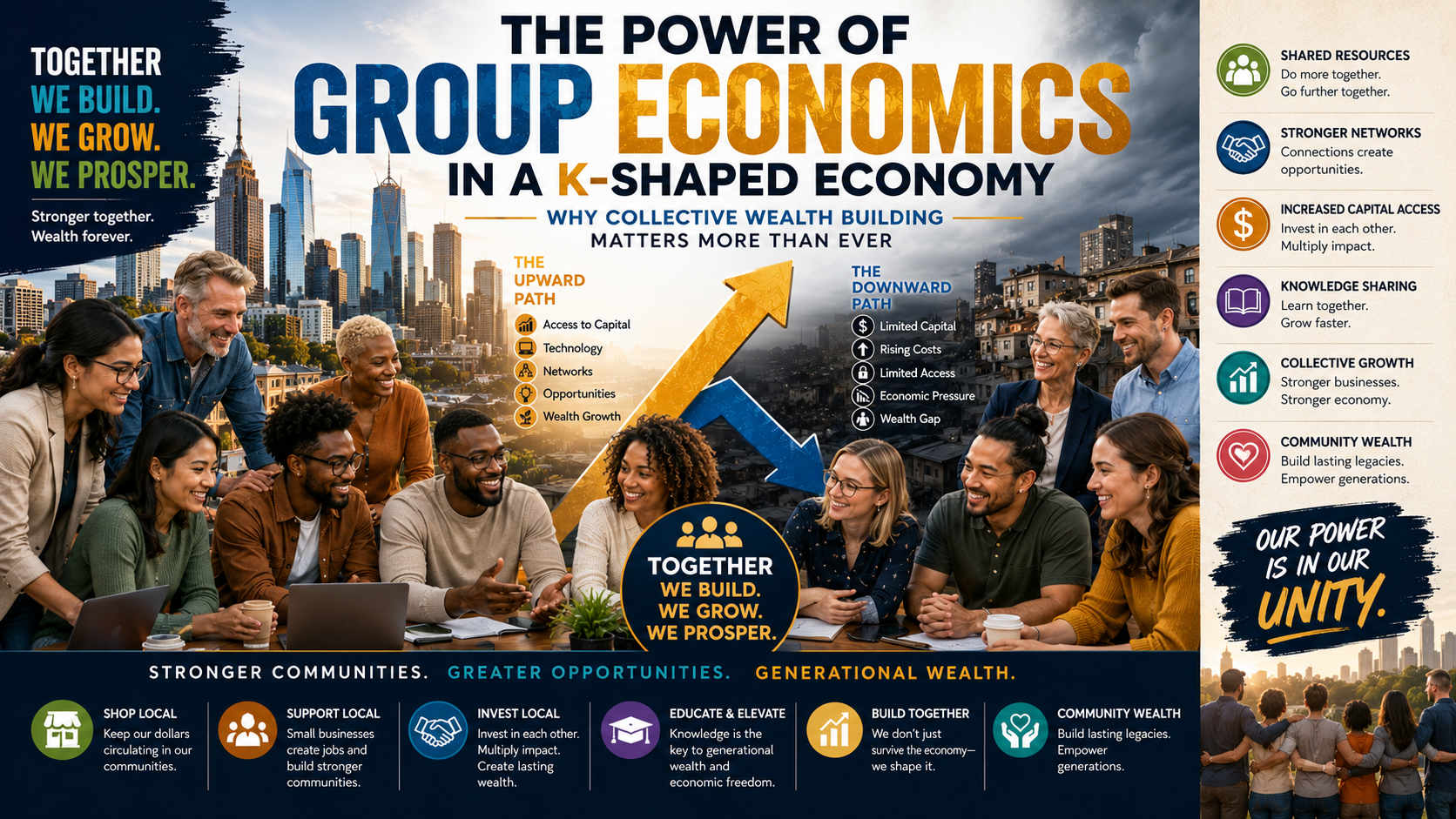
Why Collective Wealth Building Matters More Than Ever
As we move deeper into a K-shaped economy, the gap between those who are thriving and those who are struggling continues to widen. Some businesses, industries, and individuals are experiencing unprecedented growth, while others face increasing financial pressure, limited access to capital, rising costs, and economic uncertainty.
In this environment, one strategy stands out as both practical and powerful:
Group Economics.
Group economics is the concept of individuals, families, businesses, organizations, and communities working together to create, circulate, protect, and grow wealth collectively. It is not a new idea. Many of the world's most successful communities have built economic strength through cooperation, shared resources, strategic partnerships, and collective investment.
As the K-shaped economy continues to reshape the business landscape, group economics may become one of the most important tools for long-term success.
Understanding the K-Shaped Economy
A K-shaped economy occurs when different segments of society recover or grow at different rates.
One side of the "K" moves upward:
Large corporations
Technology-driven businesses
Asset owners
High-income earners
Investors
The other side moves downward:
Small businesses
Underfunded entrepreneurs
Low-income households
Communities with limited access to capital
Businesses struggling with rising costs
The challenge is clear.
Those who have access to capital, information, technology, and networks continue to advance. Those without these resources risk falling further behind.
This is where group economics becomes critical.
Why Group Economics Matters
1. Access to Greater Resources
One business may have limited resources.
A network of businesses can create opportunities that none could achieve alone.
By pooling resources, entrepreneurs can:
Share technology platforms
Reduce operating costs
Access professional expertise
Create cooperative marketing campaigns
Purchase supplies at lower costs
Increase buying power
Together, small businesses can operate with some of the advantages traditionally available only to larger organizations.
2. Increased Access to Capital
One of the biggest challenges facing entrepreneurs is access to funding.
Group economics creates pathways for:
Community investment funds
Cooperative lending circles
Angel investor networks
Business partnerships
Shared grant opportunities
Crowdfunding initiatives
When communities invest in each other, wealth remains within the community and multiplies over time.
3. Stronger Business Ecosystems
Successful economies are built on ecosystems, not isolated businesses.
Imagine a network where:
Accountants support small businesses
Marketing agencies support local brands
Financial institutions provide capital
Technology firms provide digital solutions
Nonprofits provide education and training
Every dollar spent within that ecosystem strengthens multiple businesses simultaneously.
The result is a more resilient and sustainable economic environment.
4. Knowledge Sharing Accelerates Growth
Many entrepreneurs struggle because they are forced to learn everything on their own.
Group economics encourages:
Mentorship
Business coaching
Shared learning
Strategic partnerships
Industry collaboration
When knowledge is shared, mistakes decrease and success accelerates.
Communities that learn together grow together.
5. Collective Bargaining Power
A single business often has limited negotiating power.
A network of businesses can negotiate:
Better vendor pricing
Lower insurance costs
More favorable financing terms
Improved technology contracts
Better access to government opportunities
Collective strength creates leverage.
Leverage creates opportunity.
The Wealth Creation Formula
Group economics follows a simple principle:
Keep dollars circulating longer within the community.
When money immediately leaves a community, wealth disappears.
When money circulates among local businesses, service providers, investors, and consumers, economic activity expands.
The formula looks like this:
Community Support → Business Growth → Job Creation → Wealth Creation → Community Reinvestment
The cycle repeats and grows stronger over time.
What Group Economics Looks Like in Practice
Business Networks
Entrepreneurs actively refer customers to one another and collaborate on projects.
Cooperative Purchasing
Businesses combine purchasing power to reduce costs.
Shared Services
Organizations share administrative, legal, marketing, and technology resources.
Community Investment
Local investors support local businesses and entrepreneurs.
Economic Education
Communities teach financial literacy, business ownership, wealth building, and investment strategies.
Strategic Partnerships
Businesses, nonprofits, educational institutions, and financial organizations work together toward common economic goals.
Why Group Economics Is Essential for Small Business Owners
Historically small business owners often face barriers to:
Capital
Banking relationships
Investment opportunities
Business education
Economic mobility
Group economics helps close these gaps by creating systems of support from within the community.
Rather than waiting for opportunities to arrive, communities can create opportunities together.
The goal is not simply business ownership.
The goal is:
Wealth ownership
Asset ownership
Knowledge ownership
Community ownership
Legacy creation
The Future Belongs to Collaborative Communities
The future economy will reward those who understand the value of collaboration.
Technology, artificial intelligence, automation, and globalization are changing how business is conducted. Entrepreneurs who remain isolated may find it increasingly difficult to compete.
Those who build strategic networks, partnerships, and economic ecosystems will have a significant advantage.
The question is no longer:
"How do I build my business?"
The question becomes:
"How do we build an economic ecosystem that helps all of us succeed?"
Moving Forward Together
The K-shaped economy presents both challenges and opportunities.
Some communities will continue to experience economic separation.
Others will choose a different path.
They will invest in one another.
They will share resources.
They will build partnerships.
They will create systems that support entrepreneurship, ownership, and wealth creation.
Group economics is not simply an economic strategy.
It is a community strategy.
It is a wealth-building strategy.
It is a legacy-building strategy.
And in the K-shaped economy, it may be one of the most powerful tools available for creating long-term prosperity, economic resilience, and generational wealth.
Final Thought
Alone, we can build a business. Together, we can build an economy.
The communities that master group economics today will be the communities creating wealth, ownership, and opportunity for generations tomorrow.