
Building More Than a Business: Creating Wealth, Ownership & Legacy in a K-Shaped Economy
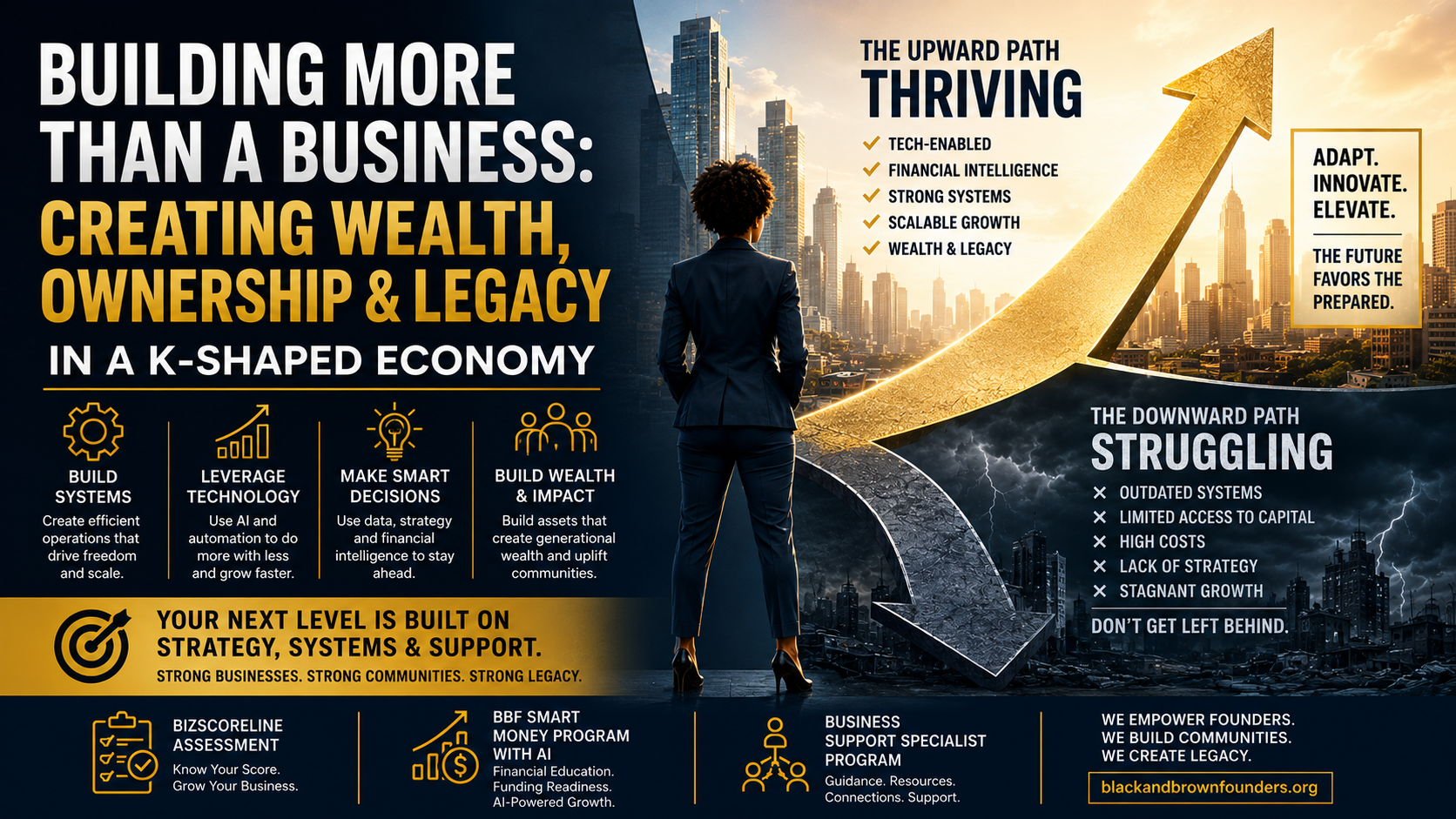
In today’s economy, small business owners are facing a reality that is reshaping industries, communities, and opportunities across America. Some businesses are growing faster than ever through technology, systems, automation, and strategic partnerships, while others are struggling to survive rising costs, economic uncertainty, and changing consumer behavior.
This divide is known as the K-shaped economy — and understanding it may determine whether a business simply survives or truly thrives.
For Black and Brown entrepreneurs, startups, and underserved communities, this moment represents both a challenge and a historic opportunity to build ownership, sustainability, and generational wealth through entrepreneurship.
What Is a K-Shaped Economy?
A K-shaped economy occurs when different groups experience the economy in opposite ways at the same time.
One side moves upward:
Higher revenue
More access to technology
Greater scalability
Increased investment and growth
The other side moves downward:
Rising operational costs
Limited access to capital
Slower growth
Economic instability
In a K-shaped economy, businesses that adapt quickly through systems, technology, AI, operational efficiency, and financial intelligence often accelerate upward, while businesses operating without infrastructure and strategy may struggle to keep pace.
Why This Matters for Small Business Owners
Small businesses are no longer competing only on products or services. They are competing on:
Speed
Systems
Customer experience
Operational efficiency
Technology adoption
Financial readiness
Brand positioning
The businesses winning in this economy are building scalable systems and sustainable business models.
This means:
Automating repetitive tasks
Leveraging AI and digital tools
Creating recurring revenue streams
Understanding financial data
Improving operational workflows
Building strong strategic partnerships
Businesses that fail to evolve risk becoming overwhelmed by inflation, labor shortages, higher marketing costs, and increased competition.
The Technology Divide Is Growing
Technology is no longer optional for growth — it is becoming essential for survival.
Businesses using:
AI tools
Automation systems
CRM platforms
Financial dashboards
Digital marketing
E-commerce systems
Business intelligence platforms
…are operating faster, leaner, and more profitably.
Meanwhile, businesses still relying on outdated manual processes often face:
Lower efficiency
Slower response times
Missed opportunities
Higher operational costs
This growing digital divide is one of the biggest drivers behind the K-shaped economy.
Building Wealth Through Ownership & Systems
Entrepreneurship has always been one of the most powerful tools for creating economic independence and generational wealth.
But building wealth today requires more than simply owning a business.
It requires building:
Systems
Infrastructure
Processes
Scalable operations
Financial stability
Transferable value
The goal is not just to create income — it is to create an asset.
Businesses that can operate beyond the owner’s daily involvement become more valuable, sustainable, and scalable over time.
How Small Businesses Can Thrive in a K-Shaped Economy
1. Focus on Operational Excellence
Businesses should consistently evaluate:
Costs
Profit margins
Customer acquisition
Productivity
Workflow efficiency
Technology integration
Operational efficiency creates stability during uncertain economic periods.
2. Use AI to Increase Productivity
Artificial Intelligence allows small businesses to:
Automate customer service
Improve marketing
Generate content
Analyze customer behavior
Streamline operations
Increase productivity with smaller teams
AI gives small businesses the ability to compete at a much larger scale.
3. Create Multiple Revenue Streams
Relying on one source of income creates vulnerability.
Businesses should explore:
Memberships
Digital products
Subscription services
Consulting
Partnerships
Licensing
Educational content
Recurring services
Diversification creates long-term stability.
4. Strengthen Financial Intelligence
Business owners must understand:
Cash flow
Credit readiness
Funding preparation
Forecasting
Financial reporting
Business valuation
Financial literacy and business intelligence are critical in a tightening economy.
5. Build Strategic Partnerships
Collaboration creates leverage.
Strong partnerships can help businesses gain:
Customers
Capital access
Technology solutions
Community trust
Distribution opportunities
Shared resources
Partnership ecosystems are becoming essential for sustainable growth.
Turning Challenges Into Opportunity
While the K-shaped economy presents challenges, it also creates opportunities for entrepreneurs willing to evolve, innovate, and build intentionally.
This is the moment for founders to:
Think long-term
Build scalable systems
Embrace technology
Strengthen operations
Invest in financial readiness
Create community-centered businesses
Businesses that focus on infrastructure, sustainability, and strategic growth can position themselves on the upward side of the “K.”
The Future Belongs to Adaptive Businesses
The future economy will reward businesses that are:
Agile
Data-driven
Systemized
Technology-enabled
Financially disciplined
Community-focused
Small business owners who commit to growth, innovation, and operational excellence will not only survive economic uncertainty — they can build lasting wealth, ownership, and legacy for future generations.
In a K-shaped economy, the question is no longer simply:
“How do we survive?”
The real question becomes:
“How do we build businesses strong enough to thrive for generations?”