
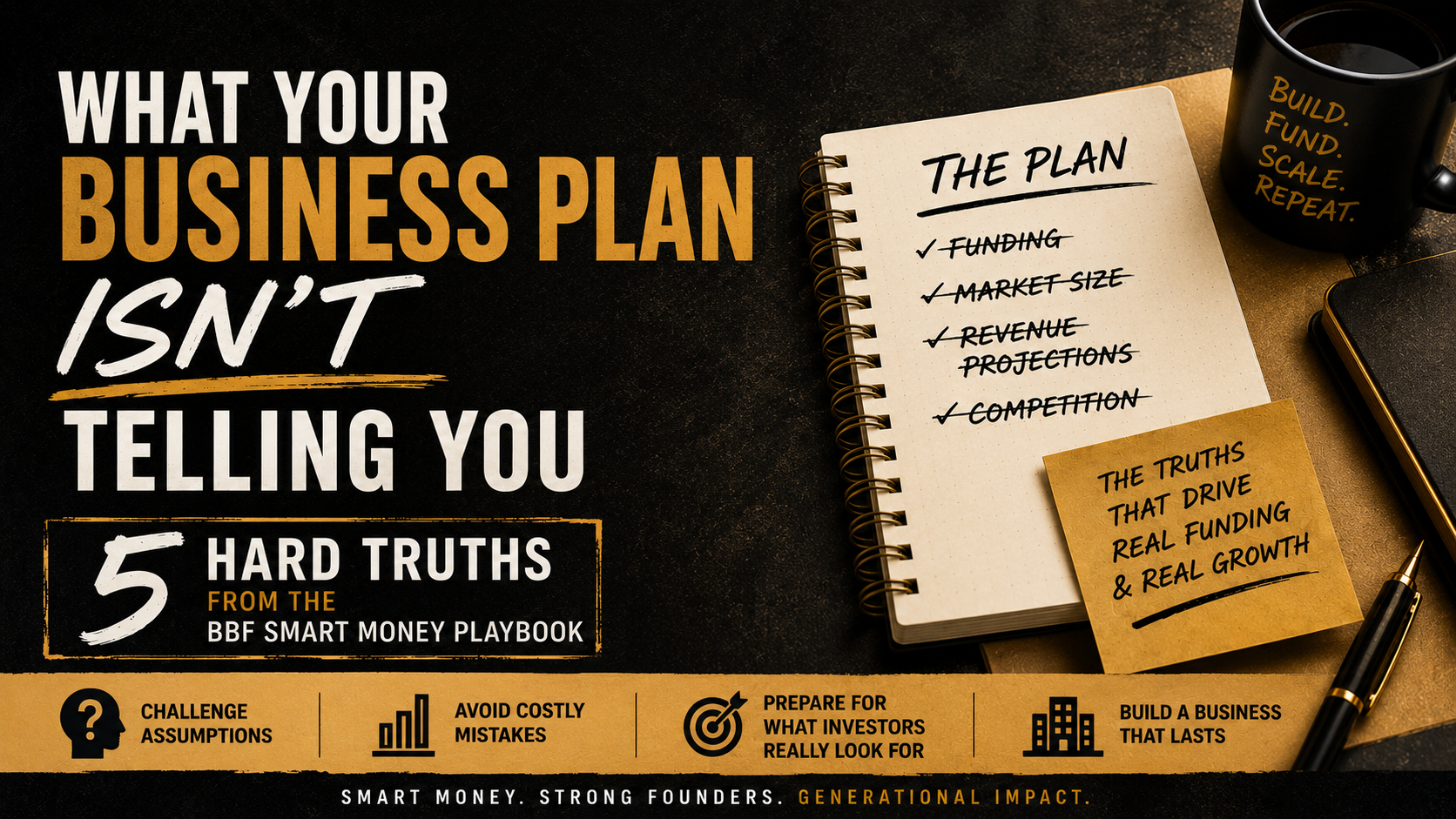
What Your Business Plan Isn't Telling You: 5 Hard Truths from the BBF Smart Money Playbook
1. Introduction: The Leap from Employee to Owner
It is the ultimate professional fantasy: handing in your notice, walking out of your corporate cubicle, and finally "being your own boss." For many of the aspiring entrepreneurs I mentor, this dream of total autonomy is what gets them through the 9-to-5 grind. But as a strategy consultant, my job is to help you move beyond the fantasy and into a sustainable reality.
Before you sign a lease or quit your day job, you need a framework that goes deeper than a standard business plan. BBF Smart Money framework provides a reality check designed to see if you have the internal and external resources to survive the first year and beyond.
2. The "Boss-Free" Life is a Myth
One of the most frequent mistakes I see is the assumption that business ownership equals total freedom. In the "Smart Money" analysis of myths and realities, two specific assumptions often lead to burnout: the idea that you won’t have a boss (Assumption 8) and the belief that ownership guarantees better work-life balance (Assumption 9).
In reality, both are false. When you own a business, you don’t eliminate the "boss"—you diversify the authority. You trade one manager for several:
Customers: Their demands and satisfaction levels now dictate your paycheck.
Lenders: If you have a loan, your bank requires strict financial adherence and transparency.
Regulators: Local and state governments impose mandatory requirements that you must follow to stay legal.
As for work-life balance? Ownership often demands more energy and time than a 40-hour week ever did. You are moving from a world of "done at 5:00" to a world where you are the final stop for every crisis.
"The content of this training material is not designed or intended to provide authoritative financial, accounting, investment, legal, or other professional advice... seek the services of a qualified professional."
3. The "BOP" Is Your Best Friend (But It Has Surprising Limits)
Risk management is where many new businesses fail before they start. Most entrepreneurs begin with a Business Owner’s Policy (BOP), which is a cost-effective bundle of three core coverages:
Property Insurance: Protects your buildings, equipment, and inventory (though I must warn you: these standard policies generally do not cover floods and earthquakes).
General Liability Insurance: Protects you from third-party claims like a customer slipping in your shop or damage caused during a service call.
Business Interruption Insurance: Replaces lost income if a fire or storm forces you to close temporarily.
Strategic owners realize that a BOP is only the foundation. It typically excludes essential protections such as Workers' Compensation, Business Auto Insurance, and—crucially for modern businesses—Data Breach Insurance. If you handle customer data, assuming your BOP covers a cyber-attack is a mistake that could end your business.
4. Your Personal Credit Dictates Your Business Operating Costs
Here is a hard truth many of my clients find counter-intuitive: your personal financial history stays with you in the boardroom. During the "underwriting" process, insurance companies don't just look at your business model; they evaluate your personal credit profile to determine your premiums.
This means that your personal past dictates your business’s future overhead. However, there is a strategic lever you can pull here: consistent, timely payments. As a mentor, I tell every client that paying your premiums on time is not just about keeping coverage; it is a strategic move to keep your credit strong, which in turn keeps your future premiums more favorable. Your financial discipline today is a direct discount on your operating costs tomorrow.
5. The Four Pillars of Strength: Beyond Technical Skill
I often see talented people like Marlena, the graphic designer in our case study, assume that being "good at the job" is enough. Marlena is a brilliant designer with eight years of experience, but her technical skill is only one piece of the puzzle. The "Money Smart" framework identifies four pillars required for success:
People Strength: Marlena has this—she’s built strong relationships with coworkers and freelancers. Ownership requires the ability to lead and resolve conflicts.
Sales Strength: You must be able to generate leads and convincingly pitch your value. Technical experts often struggle to "ask for the sale."
Financial Strength: This is the discipline to analyze cash flow and plan for taxes. It’s not about design; it’s about the "boring" math.
Self-Discipline Strength: This is the most personal pillar. It involves maintaining a lifestyle that allows you to direct maximum energy toward the business. For Marlena, this means balancing her studio dreams with the self-discipline to care for her father, who has mobility issues, and coordinating with her fiancé’s own woodworking business.
Self-discipline isn't just about working hard; it’s about healthy habits and a life structure that prevents you from running out of fuel.
6. The Home-Based Business Trap
The modern "solopreneur" often treats their home as a safe haven, assuming their standard homeowner’s insurance covers their business assets. This is a high-risk assumption. Homeowner’s insurance typically provides very little, if any, coverage for business inventory or professional liability.
To fix this, you may need a Home Business Rider—an add-on to your existing policy. However, as your consultant, I recommend that if you have significant inventory or equipment, a rider may not be enough. You may need a separate business policy to ensure a simple home accident doesn't wipe out your entire commercial investment.
7. Conclusion: Are You Ready to Take the First Step?
True readiness is more than just having a "great idea." It requires a "Resource Readiness" audit: Do you have the startup funding? Industry knowledge? The specific design hardware and software (like Marlena needs)?
I encourage every prospective owner to use the "Small Business Readiness Assessment" to bridge the gap between their current situation and their goal. Entrepreneurship is the most rewarding path you can take, but only if you walk it with your eyes open.
If you decided to pursue your business tomorrow, do you truly have the "Self-Discipline Strength" to be your own most demanding boss?